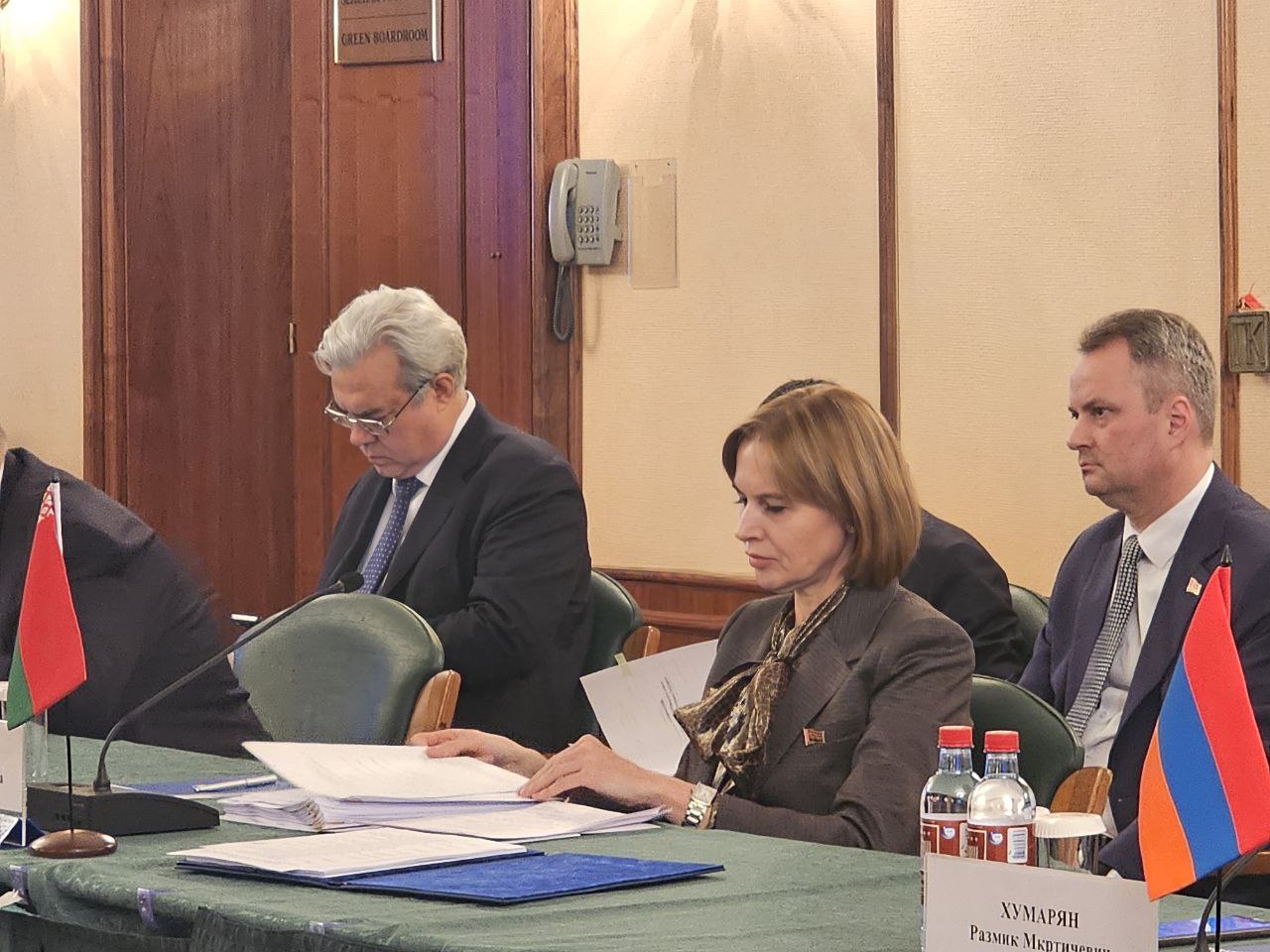
A meeting of the Economic Council of the Commonwealth of Independent States (CIS) took place in Moscow on 5 December. Belarusian Deputy Prime Minister Natalya Petkevich commented on its outcomes.
She noted that the CIS Economic Council meeting was held ahead of the upcoming CIS summit and high-level meetings. Therefore, the deputy prime ministers reviewed the final procedures before transferring a number of issues to the prime ministerial level. ‘Naturally, the main issues that are of great interest to us are the improvement of logistics. In fact, all our colleagues spoke about this today. After all, the CIS territory constitutes 16% of the world's land area. Therefore, the alignment of all logistical routes through various modes of transport is of paramount importance. Because it is not merely about transportation. It is about upgrading infrastructure, overcoming barriers, and advancing digitalization. It is a host of measures that will improve logistics across the CIS,” Natalya Petkevich stated.
“It is very positive that the CIS is operational. We consider comprehensive issues of great importance. In the process of preparing these issues, we synchronize approaches, harmonize legislation and exchange experience. This can be felt in the detailed work at the expert level as well,” she noted.
The CIS has begun operating on an international track and this is great, the Belarusian deputy prime minister said. In this context, she pointed out that the ‘CIS+’ formula extends not only to the CIS’s interaction with other integration associations as a whole. It also applies to the sectoral level. “The international track has a concrete manifestation and that is truly excellent. Today we discussed the idea of resetting the CIS towards a more concrete domain and moving from developing such a format, a formula, a certain track to pinpoint projects and specific mechanisms for various sectors,” Natalya Petkevich emphasized.
The meeting reviewed a draft concept for the alignment of major transport routes passing through the territories of CIS member states. Its main objective is to create an integrated transport system in the CIS, which will ensure safe, rapid, and efficient movement of goods between states, reduce transportation costs, and enhance competitiveness. The document will now be submitted for consideration to the CIS Heads of Government Council.
The members of the CIS Economic Council were briefed on the activities of the CIS Council for Railway Transport during the period from 2020 through the first half of 2025. The council's efforts are focused on preparing coordinated proposals for the priority areas of railway transport development, preserving the technological unity of the railway network, ensuring the coordinated development of railway infrastructure, organizing the shared use of freight cars and containers, developing a common information space, and implementing a harmonized tariff policy for international transport.
The members of the CIS Economic Council approved the draft strategy for the congress and exhibition activities of the Commonwealth of Independent States for the period up to 2030. This document will also be submitted for consideration by the heads of government.
The CIS Economic Council approved an action plan dedicated to the 35th anniversary of the CIS. It comprises five sections, encompassing over 30 important events aimed at both developing cooperation among CIS member states and strengthening and promoting the CIS as a whole. An action plan to the agreement on cooperation among CIS member states in exchanging radiation monitoring data, dated 8 June 2023, was also approved.
The CIS Economic Council endorsed a set of measures for the promotion of the use of natural gas as a motor fuel for vehicles in CIS member states for the period up to 2030. The document includes measures to stimulate demand for natural gas as a motor fuel, improve the current legal regulations, and implement initiatives aimed at increasing the attractiveness of natural gas-powered vehicles, among other goals.
The meeting approved an action plan to the strategy for hydrometeorological activities in CIS member states for 2026-2030. The plan envisions the further strengthening and expansion of international cooperation in the field of hydrometeorology.