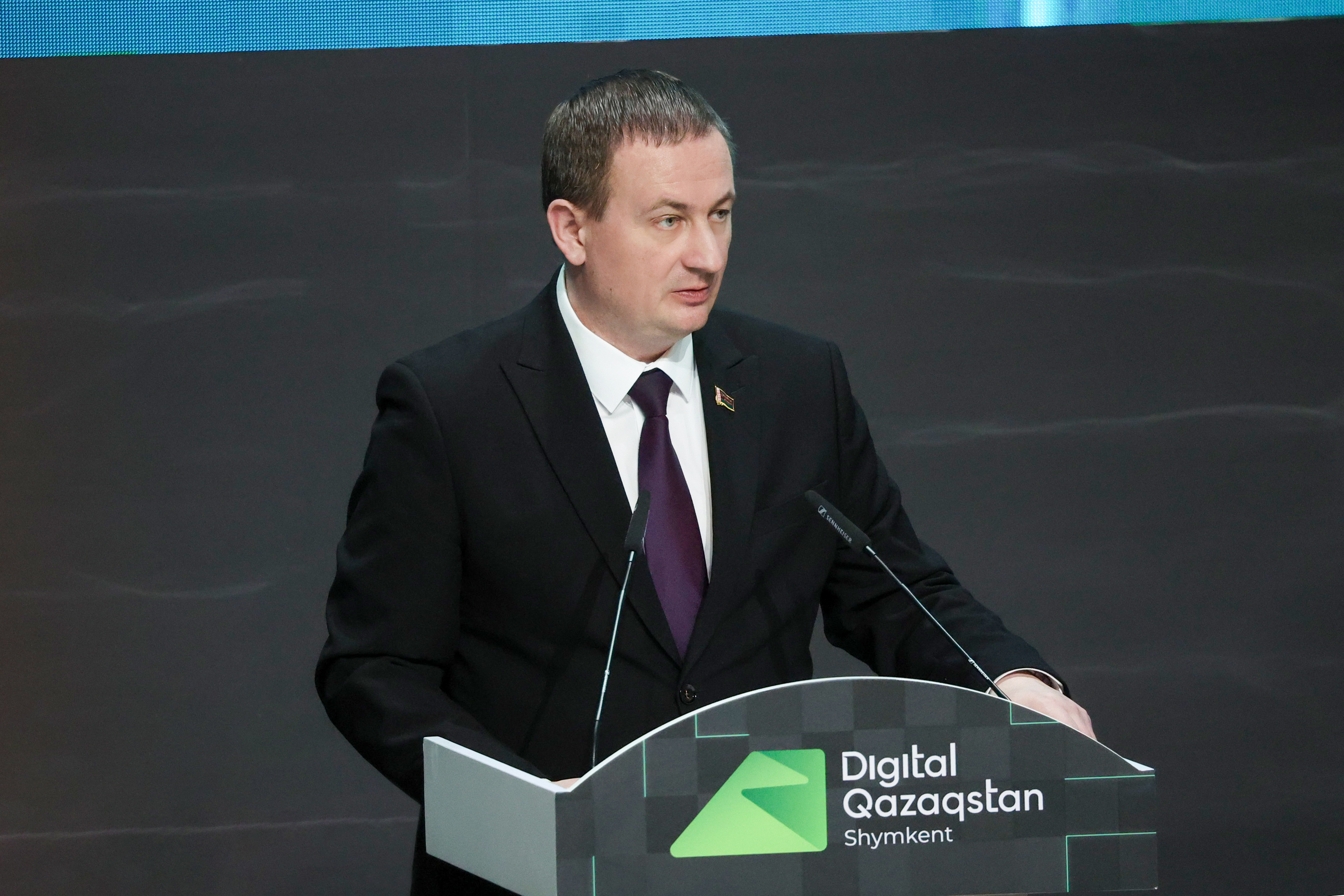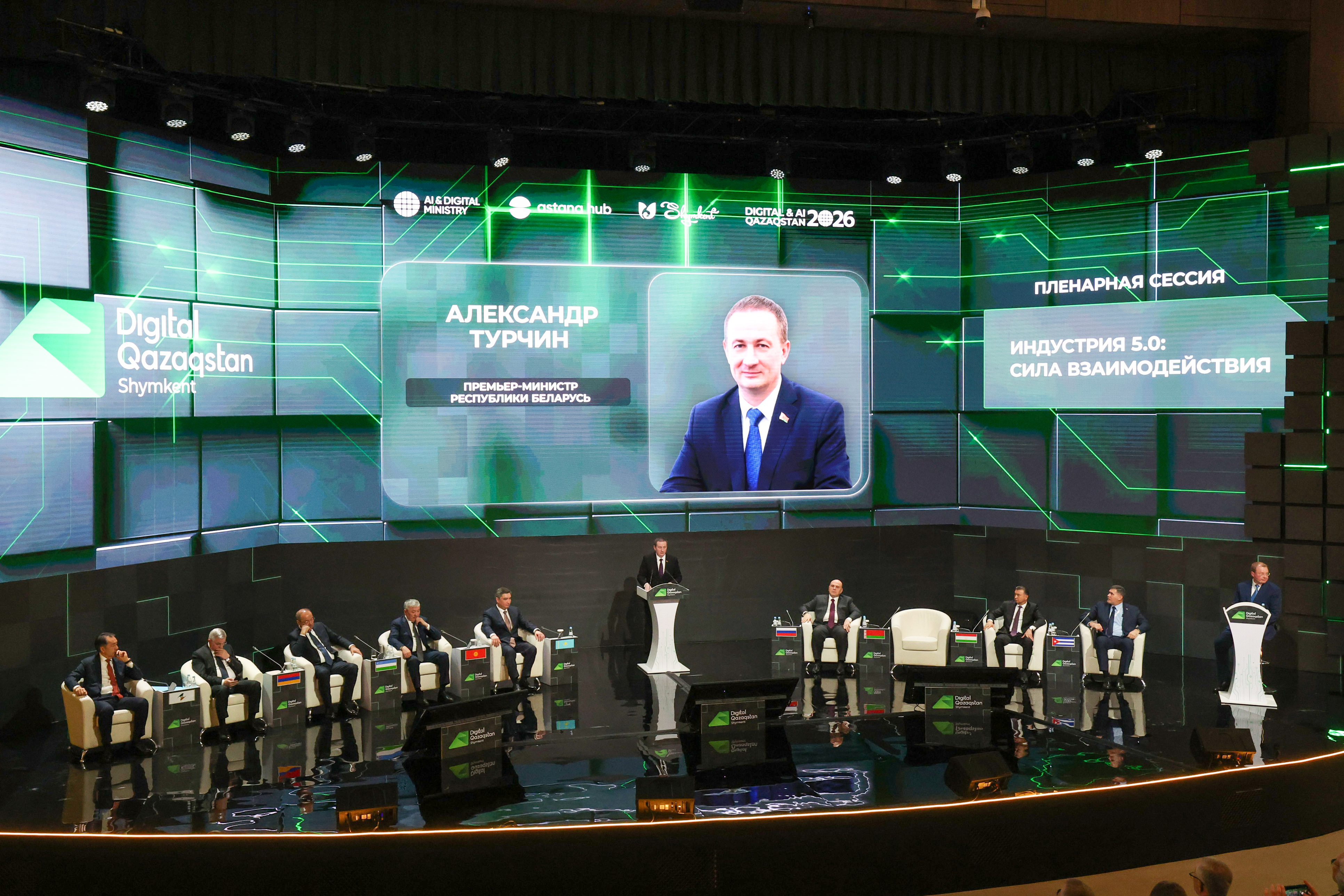
During the plenary session of the Digital forum Industry 5.0: The Power of Interaction in Kazakhstan, Belarusian Prime Minister Aleksandr Turchin outlined what Industry 5.0 means for Belarus and what strategy the country is pursuing.
The world today stands at the threshold of a new industrial era, the Head of Government noted. “The time of the 5th industrial revolution based on digital transformation, automation and robotization of production has come. For Belarus, with its strong industrial base, this is not just a trend or a fashionable concept but a strategic priority,” Aleksandr Turchin said.
“Industry 5.0 is both a guarantee and a prerequisite for increasing labor productivity and strengthening the competitiveness of Belarusian products. It is also the foundation for further developing human potential, preserving the socially oriented model of the Belarusian state, ensuring resilience to external factors, and reinforcing technological sovereignty. In this regard, special attention is being paid to priority sectors of production: mechanical engineering, mining, chemical industry, and the agro-industrial complex,” the Prime Minister emphasized.
The Belarusian state and business community are introducing new approaches to organizing production, moving from fragmented information systems to a unified digital management framework.
“One example is the well-known Belarusian dairy brand Savushkin Produkt. Around 80 robots have been integrated into the company’s production cycle. They are used to automate stacking, packaging, and labeling processes. Robots are also employed in the logistics segment, ensuring storage and movement of goods. In parallel, Savushkin Produkt has established a robotics laboratory, engaged the potential of the regional technical university to train specialists, and begun producing its own robotic systems,” Aleksandr Turchin said.
“In other words, what is being formed are not just individual modern production sites, but comprehensive industrial and social complexes that meet the challenges of the new industrial era,” the Prime Minister noted.
In mechanical engineering, the focus is on using Industry 5.0 primarily to address tasks such as ensuring worker safety in challenging environments, reducing downtime and accidents, and lowering production costs.
“Today we are testing the capabilities and exploring the prospects of an intelligent mining dump truck. This is a Belarusian project both in terms of creating the machine itself and developing the software for it. A 5G communication technology is used for connectivity, while artificial intelligence is applied to plan the truck’s autonomous operation in the quarry,” the Head of Government said.
An important condition for effective technological transformation of industry is also the creation and development of a national digital ecosystem. “The driver here is the Hi-Tech Park: the region’s leading IT cluster, often referred to as the Silicon Valley of Eastern Europe. Its resident companies develop AI- and computer-vision-based solutions already used in industry from product lifecycle management to autonomous warehouse logistics. Software systems are also widely implemented to train personnel for work at industrial facilities. This is particularly relevant for our country’s energy sector, where so-called digital simulators allow workers to practice key business processes and train for emergency situations,” Aleksandr Turchin noted.
He also drew attention to the fact that the Eurasian Economic Commission is currently carrying out extensive work on developing the Industry 5.0 concept. The core principle is shifting from simple automation to creating an environment where technology serves people rather than replaces them.
According to Aleksandr Turchin, within the EAEU space, emphasis should be placed on initiatives such as contract manufacturing and industrial outsourcing, establishing joint research and production centers for import substitution of critical components, technology transfer, and workforce training. “Belarus is ready to work actively in these areas,” the Prime Minister stressed.
Belarus possesses a broad set of competencies that enable effective development of technologies for the new industrial paradigm. These include a strong industrial base, an established engineering school, a high level of technical education, and a developed IT ecosystem capable of rapidly creating and implementing technological solutions.
“All of this we are ready to invest in joint work within the EAEU. As President of our country Aleksandr Grigoryevich Lukashenko always emphasizes, entering a new industrial era requires being among those who shape the rules of the game from the outset, rather than adapting to someone else’s norms. For any state alone, this would be extremely difficult, if not impossible. But as an integration union, the Eurasian Economic Union, we will be able to fully and directly participate in shaping the new industrial order,” Aleksandr Turchin concluded.