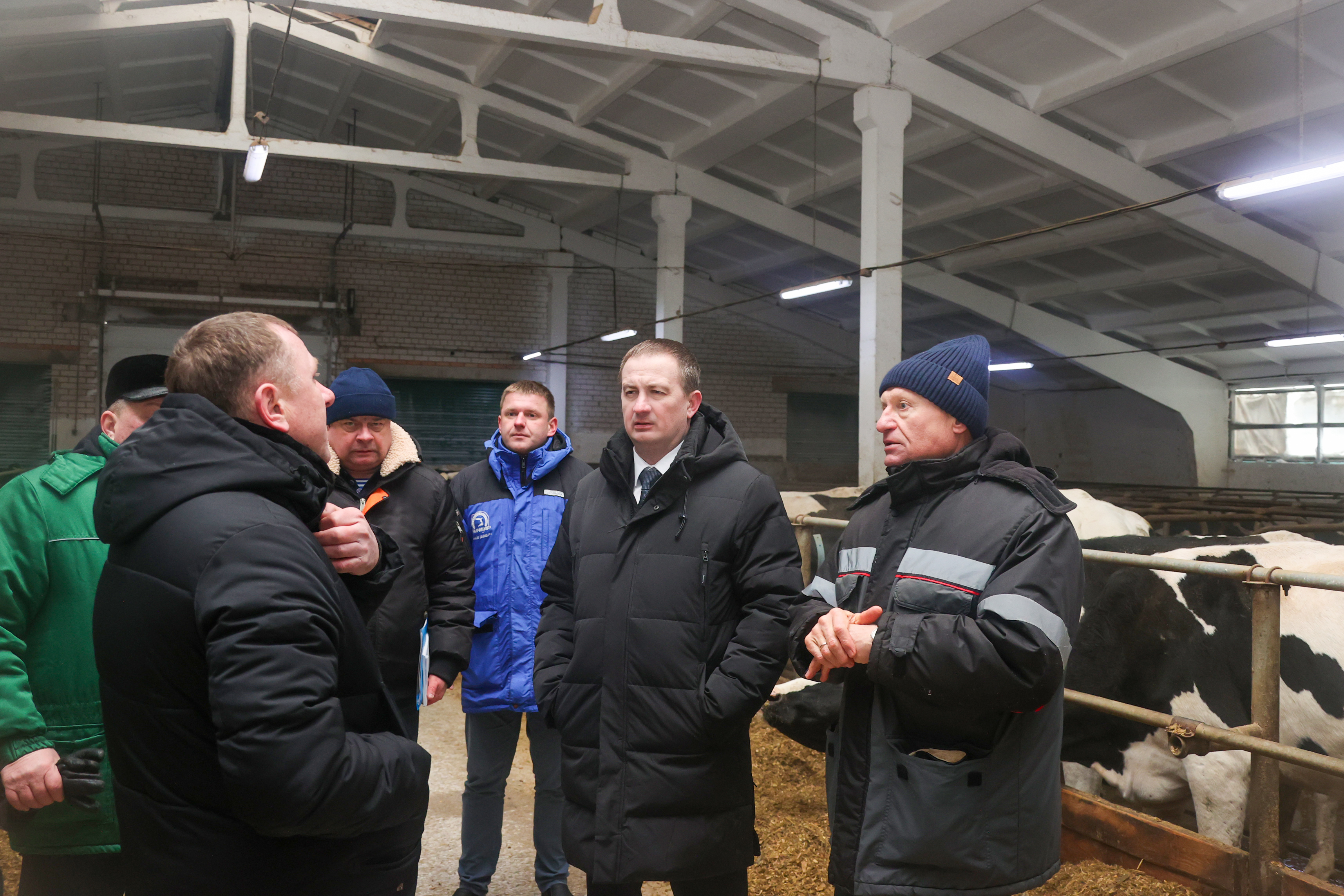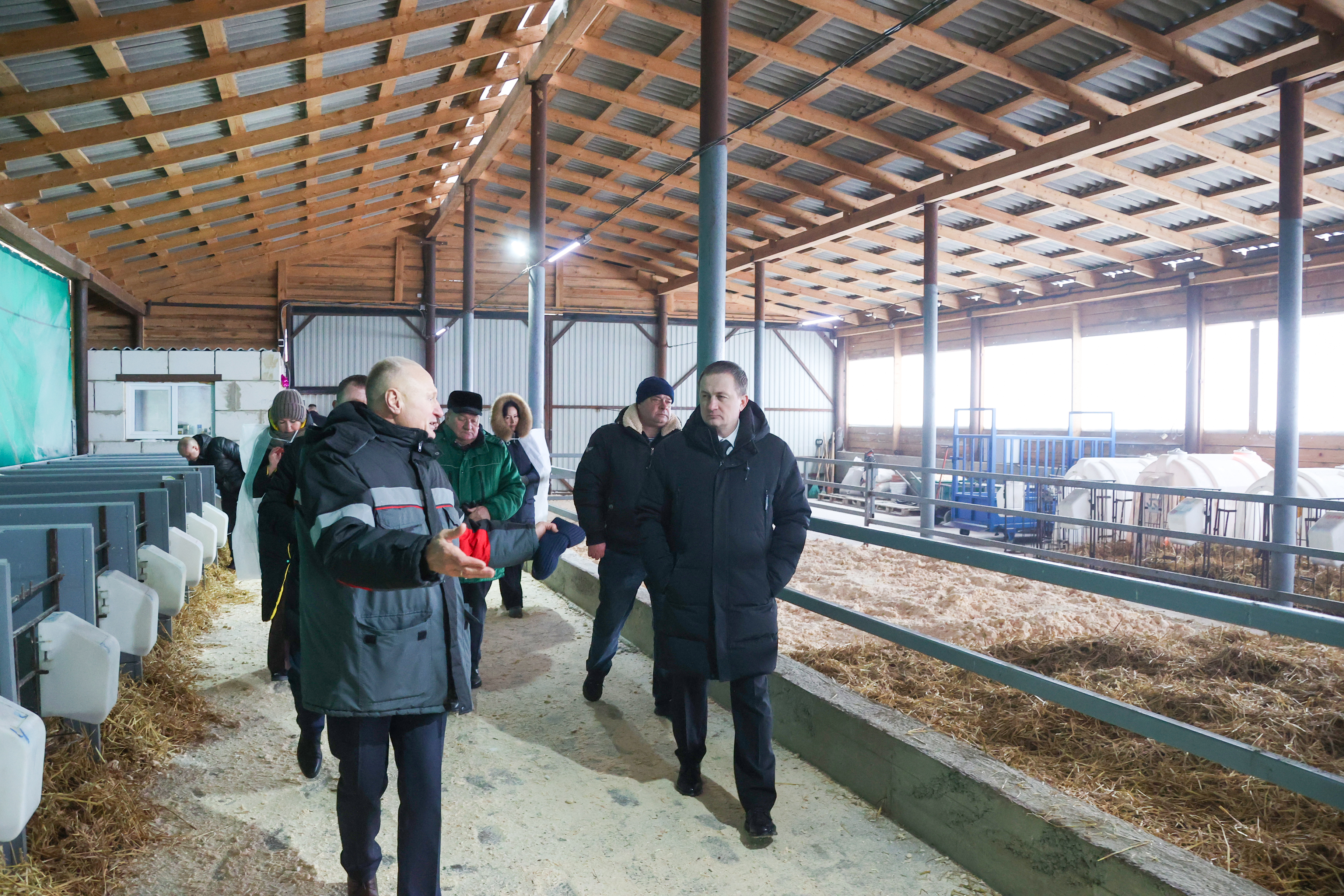
On 21 January, Belarusian Prime Minister of the Republic of Belarus Aleksandr Turchin visited the Loshnitsa dairy complex near Borisov to inspect conditions for keeping calves at the farm.
Overall, the complex is designed for 800 head of dairy cattle. The average daily milk yield per cow is 25 liters, with the complex producing between 17 and 17.5 tonnes of premium-quality milk daily.
First of all, Aleksandr Turchin visited the calf nursery at the complex. After calving, postpartum treatment, and drying, calves are brought here into individual houses or pens. Calves are kept in individual pens for 2 to 2.5 months, depending on their growth rate and the completion of all anti-epizootic measures: vaccinations and prophylactic treatments. They remain here until the age of 3 to 7 months, depending on their physiological condition. Afterwards, the calves are transferred to individual stalls for acclimatization and a gradual transition to whole milk feeding.
“Feeding calves three times a day is the standard procedure. Currently, due to the low temperatures, we have added an extra liter of milk per head, switching to four feedings a day,” Stanislav Matveyev, the chief veterinarian of the Bolshiye Novosyolki branch, said.
There are currently about 360 calves in the nursery, 56 of which are in individual pens.
“We keep calves both individually and in group pens. The scale of the nursery shows that group housing is more cost-effective. Calves represent an epizootic pool: they rub against each other, exchange biological materials, which increases their resistance and forms a microbial background. They grow stronger collectively in groups. We keep them in groups until they are 3 to 3.5 months old, until they even out in terms of physiology, growth, and body weight, just like human children: some are born smaller, some larger, but in a group they catch up. After completing all vaccinations and treatments, we separate them: bull calves go to the beef cattle fattening complex, heifers go for further rearing,” the veterinarian explained.
Calves are vaccinated several times: against ringworm, a complex of viruses, and other diseases. According to Aleksandr Turchin, the conditions for keeping young cattle are satisfactory.
As now the complex has to keep them in such frost, the most important things for the young animals are dry bedding and no drafts, Stanislav Matveyev noted. “Drafts are the main enemy. They must have dry conditions, and portioned warm milk feeding. The calves tolerate everything well,” he assured.
In turn, Aleksandr Kuretsky, director of the Bolshiye Novosyolki branch, added that the nursery was built two years ago, following the building of the main complex. The construction cost was about Br200,000.
“The temperature regime is not as crucial for young animals under proper keeping conditions as the absence of drafts,” he noted. “The average daily weight gain at the farm is over 750 grams per calf. This indicates that the rearing process is correct.”
The most important asset nowadays is having skilled personnel, and most importantly, qualified calf handlers and good milkmaids, the director believes. “That is the most important thing in any agricultural enterprise. Personnel makes difference,” he emphasized.
The Prime minister also inspected the housing of the milking cows at the complex. He noted the excellent condition of the herd, the high level of work organization, and compliance with modern standards.