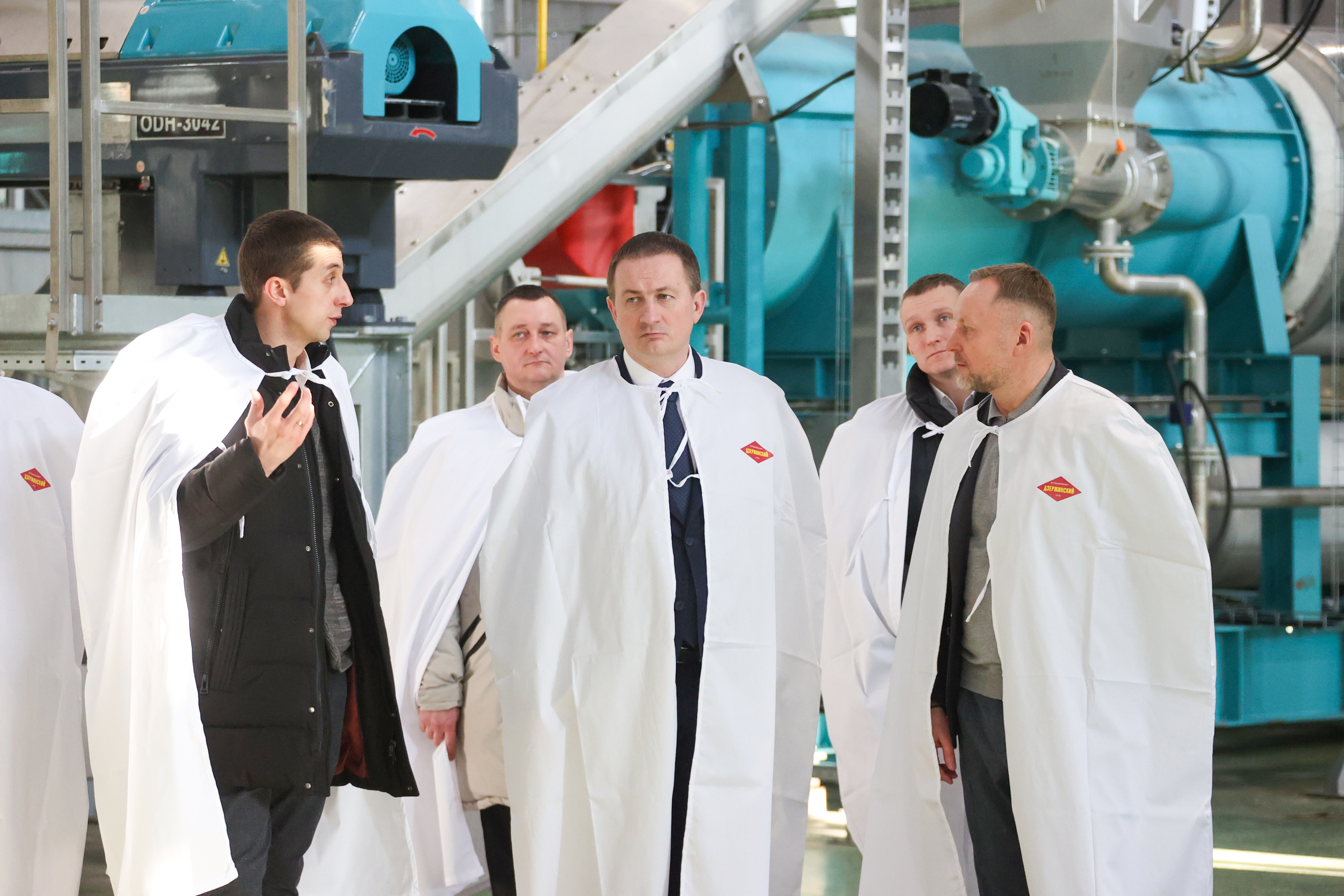
One of the largest investment projects of Agrokombinat Dzerzhinsky is nearing completion - an 80,000-tonne per year plant for processing inedible raw materials of animal origin in the Fanipol area. Belarusian Prime Minister Aleksandr Turchin was briefed on its implementation progress.
First Deputy Director General of Agrokombinat Dzerzhinsky Pavel Butko explained that the plant is designed to process raw materials left over from primary production. It consists of four separate lines: the first processes poultry slaughter by-products, the second processes feathers, the third processes blood, and the fourth processes all other types of meat waste.
The lines are fully automated, representing modern production with a staff of about 70 people, including technical specialists, technologists, and logistics personnel. “Some of the specialists already worked at the enterprise, as we were previously engaged in similar activities, and we are now actively recruiting additional staff,” said Pavel Butko.
The plant was built in a year and a half and is now 98% ready - commissioning work is underway with trial runs, electrical tests, and equipment adjustments. “Everything is proceeding successfully: we conducted a trial batch of raw material, and it went well. We measure success by the final product, it is sent for analysis, where key parameters are confirmed, ensuring further trouble-free operation,” the first deputy director general said.
The plant has been built with growth in mind. This year, it is planned to reach 60-65% of its design capacity, with full capacity expected by 2030.
Upon reaching full capacity, plans are to produce about 29,000 tonnes of finished product annually. The plant will produce five main types of products: feather meal, blood meal, meat meal, meat-and-bone meal, and feed-grade fat. “This raw material is actively used by animal feed producers - both for carnivorous and agricultural species. However, these are not finished compound feeds but ingredients for their preparation, feed additives,” Pavel Butko explained.
The enterprise is confident in product demand: the agro-industrial complex itself will consume a significant portion, and sales will target both the Belarusian market and export. “The plant unequivocally enhances the enterprise’s capacity for a complete production cycle, increasing the economic efficiency of the final product and safety. It ensures a continuous production cycle, solving the waste disposal problem not only for us but for Minsk Oblast as a whole,” the first deputy director general said.
The Prime Minister proposed studying the need and feasibility of creating a system of specialized waste processing plants across the country, taking into account the needs of each region.